Need an NIE while living, working or buying property in Calpe? This practical guide explains what a Spanish NIE number is, when you may need one and how to apply. It covers appointments, the EX-15 application form, the 790-012 fee, supporting documents, applications from outside Spain and the important differences between an NIE, residency, a TIE and the padrón.

23rd September 2026
NIE stands for Número de Identidad de Extranjero, or Foreigner Identity Number.
It is a personal and unique identification number issued to a foreign national who has an economic, professional or social connection with Spain. It normally consists of a letter, seven numbers and a final letter.
Your NIE may be requested when completing transactions such as:
The Ministry of the Interior states that the NIE identifies the foreign national and should appear on documents and procedures issued or processed for that person.

There is no general NIE service at Calpe Town Hall. The Town Hall’s OAC and padrón department handle municipal procedures, not the initial allocation of an NIE.
Applicants in Spain normally apply through an authorised National Police or immigration office. The location offered to you will depend on the procedure selected and current appointment availability in Alicante province.
Use the official government appointment service:
Book an official immigration appointment
Select Alicante as the province and look for the procedure relating to the allocation of an NIE, usually shown using wording such as:
POLICÍA - ASIGNACIÓN DE NIE
The exact wording and available offices can change. Do not travel to a police station simply because it is close to Calpe; first confirm that the chosen office handles NIE allocation and that your appointment is registered there.
The government appointment service provides the current participating offices and available procedures. For appointment-related assistance, the official help service directs applicants to telephone 060.
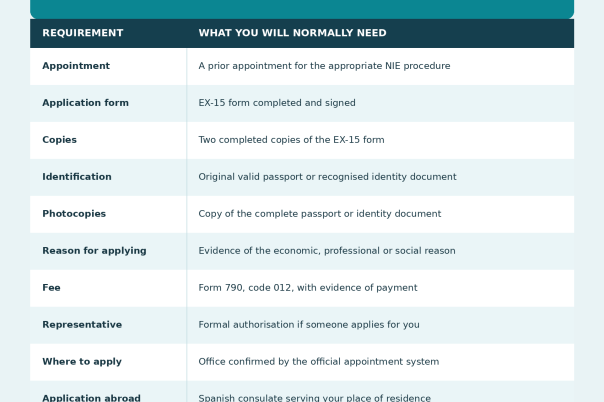
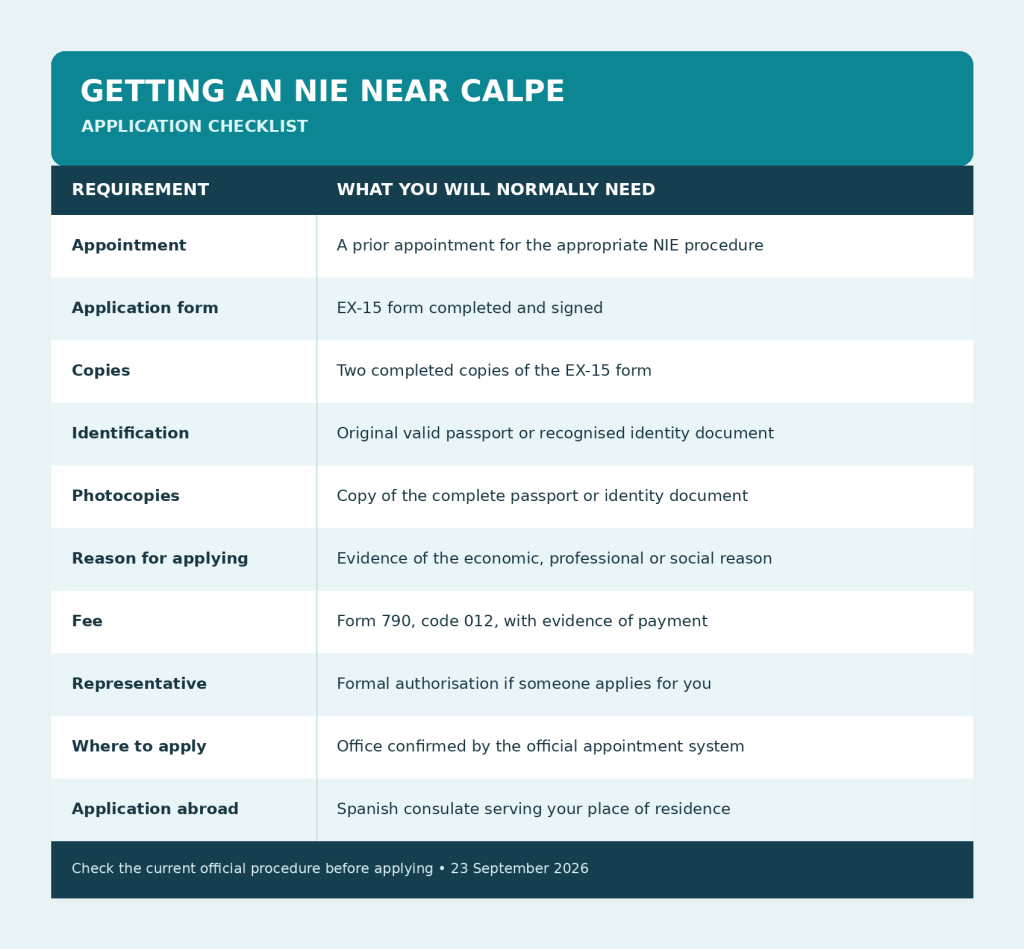
The Ministry of the Interior currently lists the following principal requirements for an application made at the applicant’s request:
The precise evidence required can depend on why you need the number.
Use the current version published through the Spanish government rather than downloading a form from an unofficial website.
Download the official EX-15 application form
Complete the official Spanish-language form. Translated copies found online may help you understand the questions, but they should not replace the official form.
The form asks for information including:
Under the reason for applying, explain clearly why the NIE is required. This could relate to a property purchase, employment, taxation, inheritance, business activity or another identifiable connection with Spain.
Take the form unsigned if your adviser or appointment office has instructed you to sign it in front of an official. Otherwise, follow the current instructions accompanying the form.
Applicants are normally required to complete Modelo 790, Código 012 and pay the applicable fee.
Access the official 790-012 fee form
The fee can change, so this guide should not publish a fixed price that may later become outdated. Generate a current form shortly before the appointment and follow its payment instructions.
Depending on the available options, payment may be made through a participating Spanish bank or electronically. Keep the stamped or validated proof of payment and take it to the appointment.
Do not confuse the 790-012 fee with payments requested by private appointment-booking or administrative services. The official administrative fee is separate from any professional fee charged by a lawyer or gestor.
An applicant must normally show a genuine economic, professional or social reason for requesting the number.
Depending on your circumstances, useful evidence might include:
Do not assume that saying you may need an NIE in the future will always be sufficient. Take documents that clearly show the transaction or procedure for which it is required.
An accredited representative, such as a lawyer or gestor, may be able to submit an application on your behalf.
They will normally need formal authority to act for you, potentially through a suitable power of attorney, together with copies of your identification and evidence supporting the application.
The wording and legalisation requirements for a power of attorney can depend on where it was signed and how it will be used. Obtain professional advice rather than using a generic online template.
Calpe Online 24 lists local professionals in its guides to:
Paid professional assistance is optional, but it can be useful when an NIE is connected to a property purchase, inheritance or more complicated immigration matter.
Yes. A person living outside Spain may be able to apply through the Spanish consulate responsible for their place of residence.
British residents should use the instructions from the appropriate Spanish consulate. Procedures and appointment arrangements vary between London, Manchester and Edinburgh.
Read the Spanish Consulate in London’s official NIE guidance
The London Consulate currently publishes its own appointment and documentation instructions, so applicants should follow that page rather than assuming the process is identical to applying in Spain.
Applying through a consulate may take longer because the consulate forwards the request to the Spanish authorities. Apply well before any property completion, notary appointment or other deadline.
The number itself is personal and remains assigned to you. You should not apply for a different number each time you return to Spain or begin another transaction.
However, an organisation may request a recently issued certificate or additional evidence of your current immigration status. This does not mean that your underlying NIE number has expired.
If you already have an NIE but cannot find the paperwork, seek advice about obtaining confirmation rather than submitting an application for a new number.
Having an NIE does not by itself:
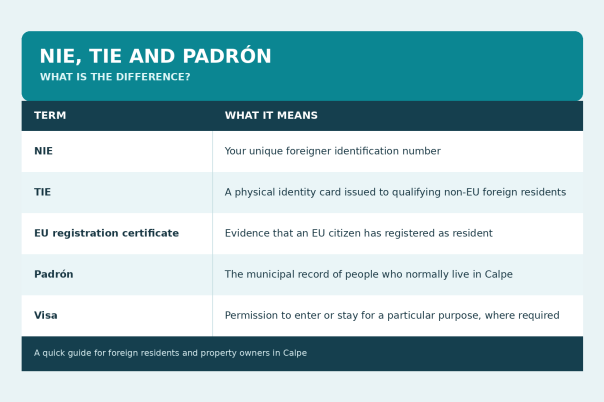
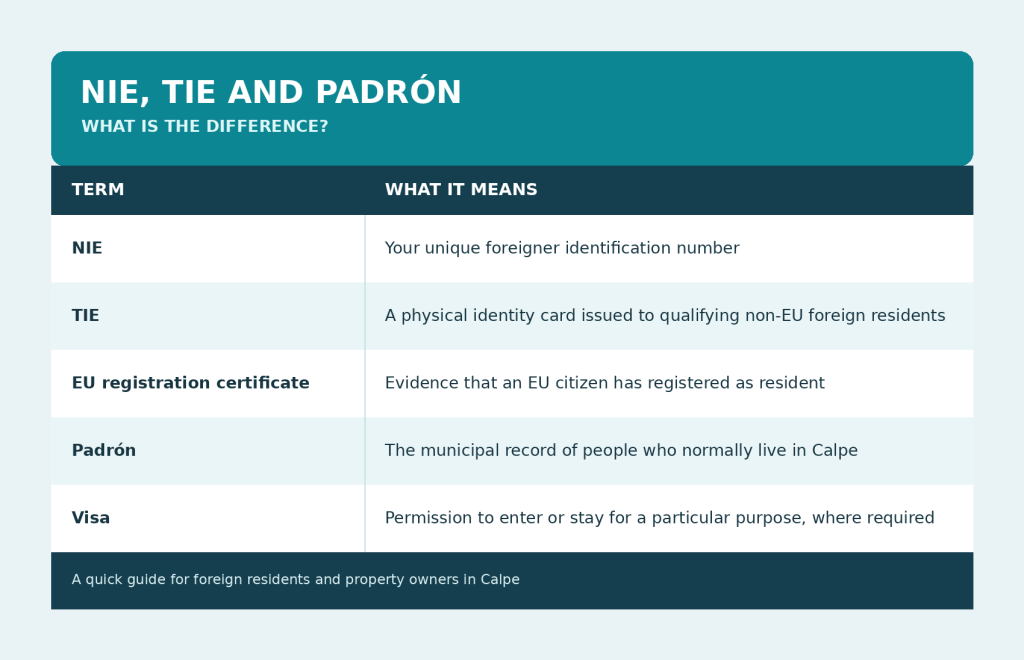
An NIE is an identification number. Your residence rights and required documents depend on your nationality, reason for living in Spain and length of stay.
EU citizens intending to live in Spain for more than three months may need to register under the EU citizen registration procedure. Non-EU citizens may require an appropriate visa, residence authorisation and TIE.
The Ministry of the Interior treats EU registration and residence cards as separate procedures with their own forms and fees.
If Calpe is your normal home, read our separate guide to registering on the padrón in Calpe.
Avoid:
Official appointment booking is completed through the Spanish government website.
You may also find these pages helpful:



 Spanish
 Chinese (simplified)
 Dutch
Dutch French
 German
 Italian
 Norwegian
 Polish
 Romanian
 Russian